What our data can’t tell us
October is Black History Month, a time to recognise and celebrate Black history, achievements and contributions, while also reflecting on the inequalities that persist.
At IFAS, we want to mark the month by acknowledging an important limitation in our own evidence base and why addressing it matters.
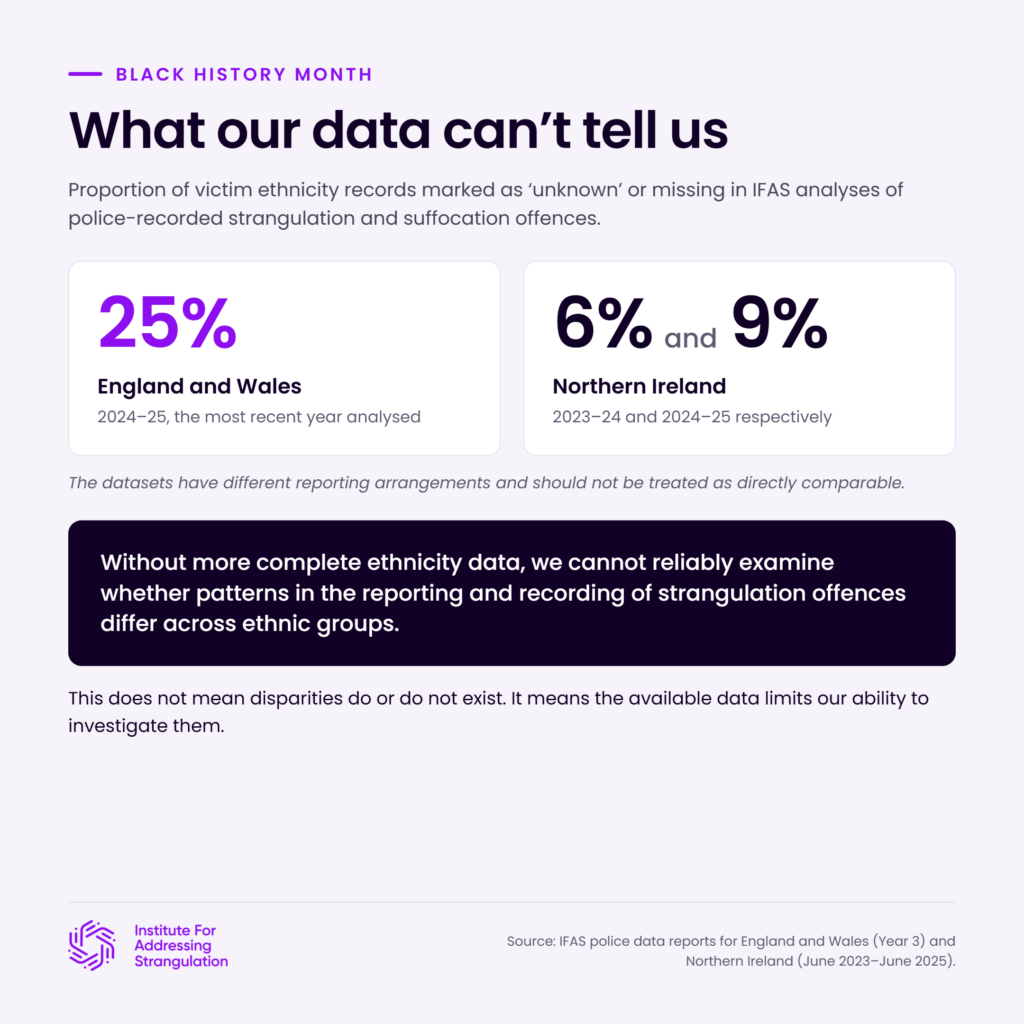
Across three years of analysing police-recorded data on strangulation and suffocation offences in England and Wales, obtained from the Home Office through Freedom of Information requests, we have consistently found significant gaps in how victim ethnicity is recorded. In our most recent analysis, a quarter (25%) of victim ethnicity records were marked as ‘unknown’.
That matters. Without more complete ethnicity data, we cannot reliably examine whether patterns in the reporting and recording of strangulation offences differ across ethnic groups or identify where further investigation into potential disparities may be needed. This does not mean that disparities do or do not exist. It means the available data limits our ability to investigate them.
In comparison, our analysis of data obtained from the Police Service of Northern Ireland found that fewer than 10% of records had victim ethnicity marked as ‘unknown’ or missing in each of the first two years. While the datasets are not directly comparable in every respect, this highlights the importance of improving the completeness of ethnicity recording.
Both reports are available in full:
There is also an important clinical consideration.
Research led by IFAS Medical Director Professor Catherine White OBE, published in the Journal of Forensic and Legal Medicine in 2026, examined the relationship between skin colour and the identification of injuries during forensic medical examinations following allegations of rape or sexual assault.
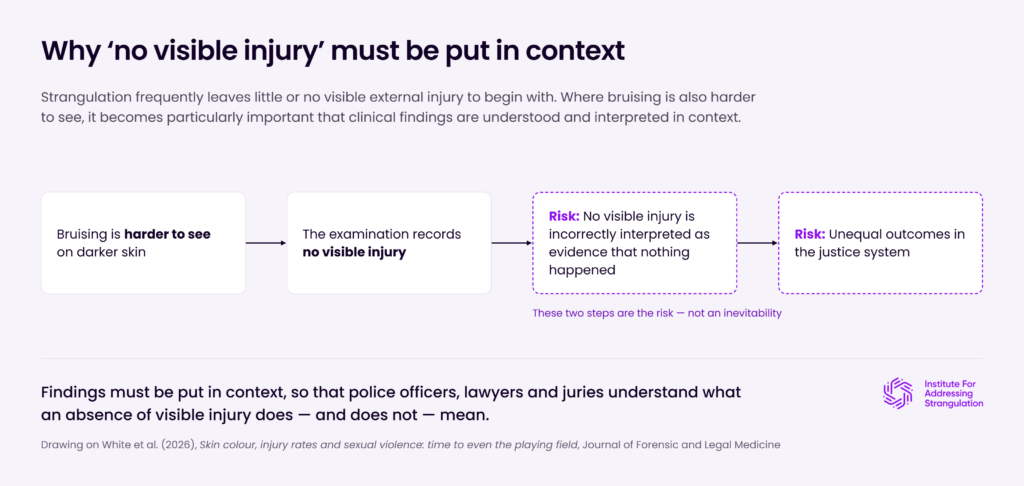
The study found that bruising on body surfaces was significantly less likely to be observed in patients with darker skin. The researchers highlighted the potential implications for both medical care and forensic evidence.
This is particularly relevant to strangulation, which frequently leaves little or no visible external injury. It reinforces the importance of recognising the limitations of visible injury assessment and ensuring that clinical practice considers how injuries may present across different skin colours.
Professor Catherine White OBE, Medical Director of IFAS shared:
“Bruising is harder to see on darker skin. That is a practical reality of clinical examination, and it matters a great deal in strangulation cases, where there is often little or no visible injury to begin with.
“What concerns me is how findings are then interpreted. When a report says that no injuries were seen, that must not be read as evidence that nothing happened, and everyone who relies on that report, from police officers to lawyers and juries, needs to understand the difference. Putting findings in context is part of doing this work properly.”
The opening session of our 2026–27 clinical webinar series, on 18 November, will also consider how the presentation and recognition of injury may vary, including considerations relating to skin colour.
We will continue to call for more consistent and complete recording of ethnicity in police data, so that we can better understand who is affected and identify where further investigation may be needed. We are equally committed to ensuring that our clinical guidance and training reflect the needs of everyone who experiences strangulation.
