More Than a Method: Understanding Strangulation as Cultural Coercion in Honour-Based Abuse
What happens when the threat of strangulation is so embedded within a language of control that the person experiencing it may not even name it as violence?
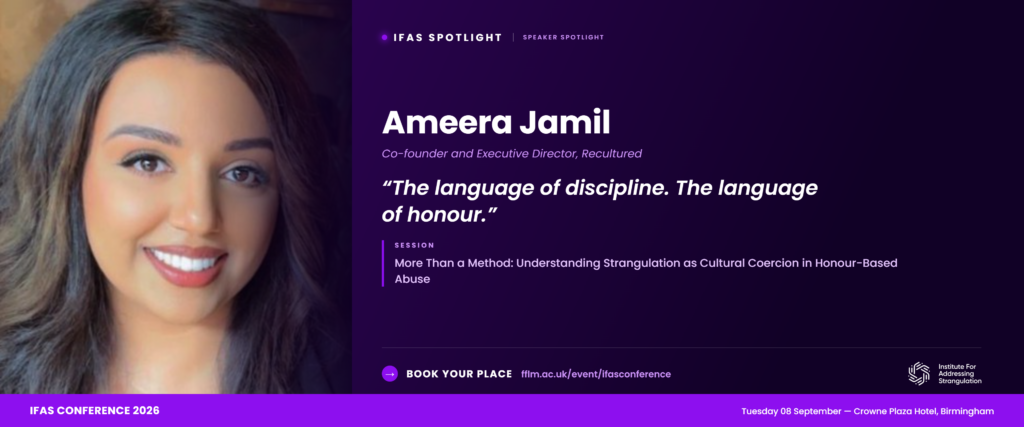
At the IFAS Annual Conference 2026, Ameera Jamil, Co-founder and Executive Director of Recultured, will bring an important and often overlooked perspective to the conversation about non-fatal strangulation: the role it can play as a mechanism of coercion and control within honour-based abuse.
Her session, More Than a Method: Understanding Strangulation as Cultural Coercion in Honour-Based Abuse, will explore not only acts of strangulation themselves, but the threat of strangulation; how that threat can enforce silence, shape behaviour and communicate the consequences of perceived disobedience or shame.
It is a subject Ameera approaches through both specialist professional expertise and lived cultural understanding.
A journey rooted in challenging silence
Ameera brings 14 years of professional experience supporting victims of harmful practices and training practitioners across higher education and related settings. Her career has spanned the voluntary sector, law and higher education, including several years with Karma Nirvana, the national charity supporting victims and survivors of honour-based abuse and forced marriage.
Today, alongside her role within the Advice and Response team at the University of Manchester, Ameera leads Recultured, the specialist organisation she co-founded to reform how UK higher education responds to harmful practices, including honour-based abuse, forced marriage and female genital mutilation.
Her work is grounded in a fundamental question: what happens when the systems intended to protect people do not have the language, knowledge or structures to recognise the harm they are experiencing?
That question has followed Ameera throughout her career.
Her academic work examined the extent to which universities incorporated forced marriage and honour-based abuse into institutional policy – early applied research that would ultimately help lay the conceptual foundations for Recultured’s Harmful Practices Response Index.
Turning that gap into evidence
Published in June 2026, Recultured’s Harmful Practices Response Index provides the first systematic, evidence-based assessment of how higher education institutions across the UK respond to honour-based abuse, forced marriage and female genital mutilation.
Following standardised Freedom of Information requests across England, Scotland, Wales and Northern Ireland, 125 institutions provided substantive responses, spanning seven dimensions of safeguarding policy and practice.
What emerged was a striking picture of how easily harmful practices can become invisible within systems that are not equipped to recognise them.
91% of institutions had no specific recording categories for honour-based abuse, forced marriage or FGM. Instead, disclosures were commonly absorbed into broader categories such as domestic abuse, safeguarding or ‘other’, making it difficult for institutions to identify and understand them as distinct forms of harm.
The training gap was equally significant: 85% of institutions had no specialist training on honour-based abuse, forced marriage or FGM.
These are not simply administrative gaps. They raise deeper questions about recognition and disclosure.
If a form of abuse is not named within the systems, policies and conversations surrounding someone, how easily can they recognise that what they are experiencing is something they can disclose – and how prepared will the professional receiving that disclosure be to understand it?
Bringing cultural understanding into the conversation about strangulation
That question becomes particularly important when considering non-fatal strangulation within the context of honour-based abuse.
Honour-based abuse is not synonymous with any one religion, nationality or community. Nor should culture ever be used to excuse abuse.
But understanding the cultural and social context in which violence occurs can be critical to recognising the form that coercion takes, the people who may be involved and the barriers someone may face in naming or disclosing what is happening to them.
Generic frameworks can provide a starting point, but they cannot become the ceiling of our response.
Recultured’s research highlights the distinctive dynamics that can be present within honour-based abuse and forced marriage, including multiple perpetrators, wider family and community networks, and coercive dynamics that require specialist understanding alongside broader domestic abuse frameworks.
Ameera’s conference session takes that understanding into a conversation that has received far less attention: the cultural role of strangulation as both threat and control.
In describing the cultural context behind her session, Ameera reflects on a phrase she says will be instantly recognisable to many people who have grown up in South Asian families: “I will strangle you.”
As Ameera explains, this may not always be understood by the person hearing it as a formal threat of violence. It can become embedded within the language used in response to perceived disobedience or behaviour considered to bring shame – what she describes as “the language of discipline. The language of honour.”
The significance of that normalisation can be profound.
A threat does not necessarily need to be carried out to influence behaviour. Repeated over time, it can communicate consequences, enforce silence and operate as a mechanism of coercion and control. And where someone has grown up hearing that language, they may not necessarily identify or disclose it as violence in the way a practitioner expects.
That creates important questions for professionals.
What are we missing if we only ask about physical acts and not threats? What happens when the language used by a victim or survivor does not match the terminology used by services? And how do clinical assessment, evidence gathering and risk identification change when we understand the wider cultural context in which strangulation may occur?
These are difficult questions. They are also necessary ones.
Visibility as part of safeguarding
One of the most powerful observations within Recultured’s research is that community-specific visibility can itself form part of safeguarding infrastructure.
The report explains that explicitly naming harmful practices – through visible resources, dedicated provision, trained professionals or targeted awareness activity – can signal institutional understanding and help create the conditions in which a first disclosure becomes possible.
That principle has relevance far beyond higher education.
If we want people experiencing strangulation within different cultural and community contexts to recognise it, name it and seek support, then those experiences need to be visible within the conversations professionals are having about non-fatal strangulation.
And professionals need the knowledge and confidence to hear what someone is telling them, even when they do not use the words we expect.
More than a conference session
At the IFAS Annual Conference, Ameera will draw together specialist practice, research and lived cultural understanding to explore what strangulation can signal within this context and what that means for professionals across healthcare, forensic medicine, policing, safeguarding and advocacy.
She will also draw on case learning from serious honour-based abuse cases in the UK to examine how strangulation can feature not only as a method of fatal violence, but within patterns of threat and coercive control preceding it.
Her contribution also reflects something broader about the work still ahead of us.
Improving our understanding of non-fatal strangulation cannot only mean knowing more about the act itself. It must also mean understanding the context in which it occurs, the meaning it may carry, the coercion surrounding it and the barriers that can prevent someone from recognising or disclosing what has happened to them.
Because if we do not understand the context, we risk missing the harm.
And if we do not name the harm, we risk leaving people experiencing it unseen.
Ameera Jamil will present More Than a Method: Understanding Strangulation as Cultural Coercion in Honour-Based Abuse at the IFAS Annual Conference 2026 on Tuesday 8 September in Birmingham.
About Ameera Jamil:
Ameera Jamil is Co-founder and Executive Director of Recultured, a specialist training and consultancy organisation working with UK higher education institutions on harmful practices, specifically honour-based abuse, forced marriage and female genital mutilation.
Ameera brings 14 years of experience across the voluntary sector, law and higher education, including frontline work supporting survivors of honour-based abuse and forced marriage. Alongside her institutional and research work, she brings lived cultural expertise to her practice and delivers specialist training to higher education institutions across the UK.
