Leading Through Curiosity, Collaboration and Change: Professor Catherine White’s Vision for IFAS
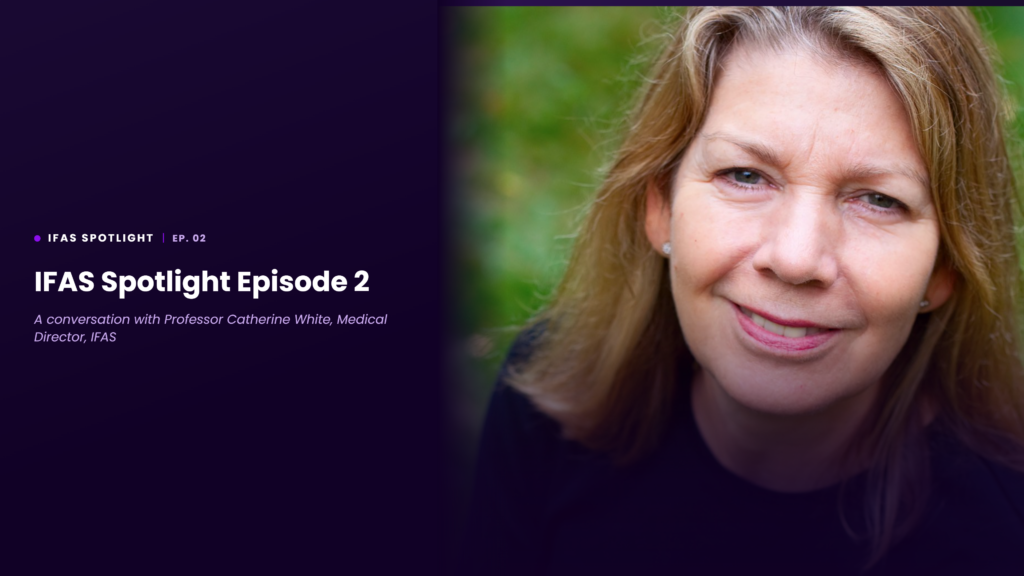
Highlighting the people, partnerships and ideas shaping research, practice and prevention.
As part of our new IFAS Spotlight series, we sit down with the people, partners and professionals helping shape the future response to strangulation. Through these conversations, we explore the experiences that have shaped their careers, the challenges they see today, and their hopes for the future. In our latest conversation, we spoke with Professor Catherine White, Medical Director of the Institute for Addressing Strangulation (IFAS).
“I’d never heard of the centre. I didn’t know what a forensic doctor did. I just thought it sounded interesting.”
It is perhaps not the answer you might expect from someone whose research helped shape a landmark change in the law and who has spent more than three decades advancing forensic medicine, clinical practice and professional education. Yet for Professor Catherine White OBE, curiosity has quietly shaped an extraordinary career dedicated to improving care, advancing research and strengthening the response to victims and survivors of violence.
Professor White’s journey into medicine began without a family background in healthcare. Like many doctors of her generation, she balanced the demands of medical training with raising a young family, completing hospital rotations during an era of 100-hour working weeks before qualifying as a GP.
Emergency medicine appealed to her, but family life required a different path. It was while working as a GP that she came across an advert seeking female doctors to train as forensic physicians at St Mary’s Sexual Assault Referral Centre.
“I’d never heard of the centre,” she recalls. “I didn’t know what a forensic doctor did, but I just thought it sounded interesting.”
That single decision would define much of her professional life.
Today, Professor White combines clinical practice, academic research and forensic expertise to help shape the UK’s understanding of strangulation and its devastating consequences. Through her work as Medical Director of IFAS and her wider national and international collaborations, she continues to support improvements in professional practice, education and research that place victims and survivors at the centre of the response.
Alongside her leadership in the UK, Professor White has played a significant role in advancing forensic medicine, clinical education and professional practice internationally. As a UN Expert on Sexual Violence, she contributed to the development of forensic medical training for the Palestinian National Authority and Egypt. She has delivered training for clinicians and police officers in Cambodia, supported by UNICEF and the Child Exploitation and Online Protection (CEOP) Centre, worked with judges, clinicians and police in Moldova, and been a member of the UK team delivering training to the French judiciary. Through the European Family Justice Centre Alliance and other international collaborations, she continues to lecture on strangulation, supporting professionals to share evidence, strengthen clinical practice and improve outcomes for victims and survivors. Her expertise has also been sought internationally through independent reviews of specialist sexual assault services in Australia and New Zealand, reflecting her reputation for advancing excellence in clinical forensic practice.
Beyond awareness
For Professor White, raising awareness is only the beginning.
She believes lasting change depends upon ensuring that professionals across healthcare, policing, criminal justice, education and the specialist sector are able to recognise the consequences of strangulation, ask the right questions and respond appropriately.
“Greater knowledge and awareness” remains one of her core ambitions, but awareness alone is not enough.
Many professionals, she explains, may already be seeing the consequences of strangulation without recognising them as such. Improving understanding means enabling clinicians and practitioners to ask the right questions in ways that allow victims and survivors to disclose their experiences safely and receive appropriate support.
Ultimately, however, her vision extends beyond better recognition.
“Ideally, we’d be stopping it in its tracks anyway.”
Her aspiration is ambitious but remarkably simple: that strangulation becomes something future generations only learn about in history.
“Wouldn’t it be great if non-fatal strangulation became something you learn about in a museum? People would say, ‘Is this really what people used to do?”
Collaboration creates change
Throughout her career, Professor White has consistently returned to one principle: meaningful change happens when organisations work together.
Reflecting on her time at St Mary’s Sexual Assault Referral Centre, she recalls establishing informal community mornings after realising that local organisations working only a short distance away knew little about one another’s services.
Over coffee and conversation, charities, community groups and healthcare professionals came together simply to learn about each other’s work.
Those conversations built relationships that formal meetings often cannot.
If a community organisation understood what specialist services could offer, it became far easier for survivors to be connected with the right support when the opportunity arose.
Professor White sees the same opportunity for IFAS today.
Rather than waiting for organisations to discover the Institute, she believes IFAS can proactively create welcoming spaces where professionals and community organisations learn from one another, build trusted relationships and develop the confidence to recognise strangulation across different settings.
It reflects IFAS’s commitment to partnership working and the belief that meaningful change is achieved when organisations work together.
Research that reaches practice
As Medical Director, Professor White also sees research as something that must influence everyday practice.
Evidence is only valuable if it changes what professionals do.
For Professor White, research should not end with publication; it should influence practice, inform policy and ultimately improve outcomes for victims and survivors.
That means translating research into practical guidance, education and conversations that support clinicians, practitioners and decision-makers alike.
It also means ensuring victims and survivors remain at the heart of every conversation.
Professor White believes society has an opportunity to fundamentally shift how strangulation is understood.
Through research, education, collaboration and systems change, IFAS is helping build greater awareness across healthcare, policing, criminal justice and the specialist sector.
For her, success will not simply be measured by reports published or professionals trained.
It will be measured by fewer people experiencing strangulation, more professionals recognising its consequences and stronger partnerships working together to prevent harm before it occurs.
Her hope is that future generations will look back at strangulation with disbelief – something they learn about in a museum rather than experience in their lives.
Achieving that vision will require curiosity, collaboration, evidence and a collective commitment to changing practice. It is a challenge that IFAS cannot achieve alone, but one it is determined to lead alongside its partners.
About Professor Catherine White
Professor Catherine White OBE is Medical Director of the Institute for Addressing Strangulation (IFAS), Honorary Professor at The University of Manchester and a practising forensic physician at St Mary’s Sexual Assault Referral Centre. Awarded the David Jenkins Chair by the Faculty of Forensic & Legal Medicine in 2023, she has spent more than three decades leading developments in clinical forensic medicine, research, education and international collaboration to strengthen professional responses to sexual violence and strangulation while improving outcomes for victims and survivors.
