IFAS statement on the death of a 16-year-old girl in Sydney and the language used to describe strangulation during sex
The Institute for Addressing Strangulation (IFAS) is deeply saddened by reports of the death of a 16-year-old girl in Sydney, Australia, following an incident that is being investigated by police and has been reported as involving suspected strangulation during sex. Our thoughts are with her family, friends and community.
While the circumstances and cause of her death remain under investigation, this tragic case has understandably opened the wider conversation about strangulation during sex, and the way it is becoming increasingly normalised, particularly among young people, and the language used to describe it.
At IFAS, we believe that language matters because it helps shape how risk is understood.
The term “choking” is frequently used in media reporting, pornography and everyday conversation to describe pressure being applied to someone’s neck, particularly when talked about in the context of sex. Clinically, however, choking and strangulation are different.
Choking occurs when the airway is obstructed internally, for example by food. Strangulation occurs when external pressure is applied to the neck, restricting airflow and/or blood flow to and from the brain.
When we call strangulation “choking”, including “sexual choking”, we risk making a dangerous act sound less serious than it is. A sexual context does not change what is happening to the body when pressure is applied to the neck. The anatomical structures of the neck are vulnerable regardless of the strangulation.
At IFAS, we are clear: There is no safe way to strangle.
Strangulation can cause serious harm, including loss of consciousness, neurological injury including stroke, and in some circumstances can be fatal. Importantly, serious harm can occur without visible marks, which means the absence of injury should never be taken as reassurance.
IFAS is particularly concerned about the increase in the normalisation of strangulation during sex among young people. Our UK survey of 4,175 people indicates that over half of all respondents (55%) have either been strangled or strangled someone during sex, reinforcing the need for accurate, evidence-based information that is not shaming, not sensationalist and not silent about the risks, but provides the facts and evidence to create better understanding.
The UK has also taken legislative action. The Crime and Policing Act 2026 criminalises the possession and publication of pornography depicting strangulation or suffocation, following recommendations from Baroness Bertin’s Independent Pornography Review and growing evidence about the normalisation of strangulation through pornography.
Bernie Ryan, CEO of the Institute for Addressing Strangulation, said:
“First and foremost, our thoughts are with the family and friends of this young person. We must be careful not to speculate about the circumstances of her death while the police investigation continues.
“What this tragedy has brought into sharp focus, however, is something that IFAS speaks about often, the need for us to talk honestly and accurately about strangulation.
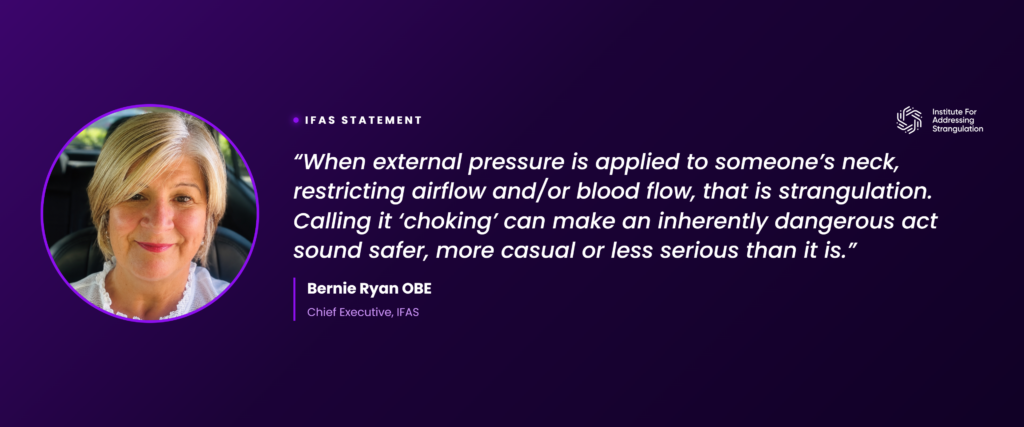
“When external pressure is applied to someone’s neck, restricting airflow and/or blood flow, that is strangulation. Calling it ‘choking’ can make an inherently dangerous act sound safer, more casual or less serious than it is.
“We know that many young people are encountering strangulation through pornography, social media, and peer conversations before they perhaps have had the opportunity to understand the facts about what strangulation can do to the body and the impact. That is why education has to be clear, evidence-based, age-appropriate, and non-judgemental. At IFAS, we’re working with educators, youth organisations, health professionals and others to explore how we can have these conversations in ways that genuinely connect with young people. We have to meet them where they are, acknowledge the reality of what they’re seeing and hearing, and provide accurate, evidence-based information, including that there is no safe way to strangle.
“The media, educators, policymakers, healthcare professionals and all of us working with young people have an important role to play in getting both the language and the information right. The words we use really do matter to help shape how risk is understood – and understanding that risk matters.”
IFAS will continue to work with survivors, clinicians, researchers, policymakers, educators and professionals across sectors to improve understanding of strangulation, its risks and the responses needed to prevent harm.
