Building a Future Where No One Is Overlooked
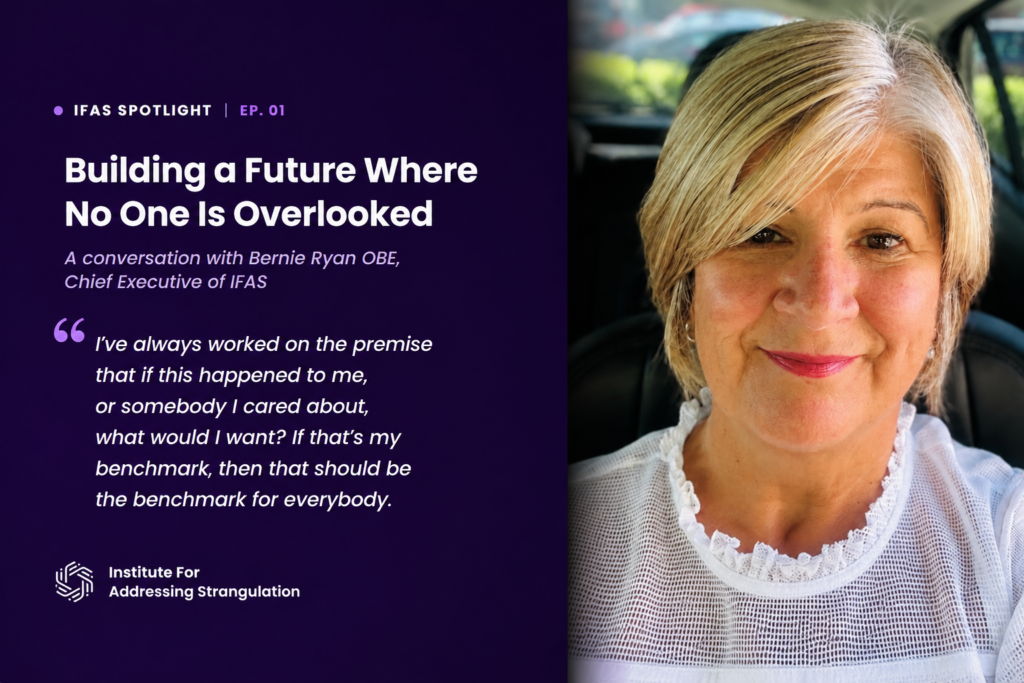
A conversation with Bernie Ryan OBE, CEO of IFAS
For Bernie, improving the response to victims and survivors has never been about one organisation, one profession or one part of the system. It has always been about bringing people together to understand problems better, listen more carefully and create lasting change.
After spending almost her entire career in the NHS – first as a nurse specialising in women’s health and later leading St Mary’s Sexual Assault Referral Centre in Manchester alongside IFAS Medical Director Professor Cath White – Bernie has dedicated decades to improving services for victims and survivors of sexual violence.
Looking back, she describes a career shaped by one simple question:
“I’ve always worked on the premise that if this happened to me, or somebody I cared about, what would I want? If that’s my benchmark, then that should be the benchmark for everybody.”
That philosophy has guided every stage of her career.
From developing one of the UK’s first Sexual Assault Referral Centres into a nationally recognised centre of excellence, to advising police forces, healthcare services and specialist organisations across the country, and contributing to the development of services internationally. Bernie has always believed meaningful change happens when organisations work together rather than in isolation.
A public health approach built on collaboration
Throughout her career, Bernie has worked across healthcare, policing, criminal justice, social care and specialist support services.
“I’ve always worked from a systemic approach,” she explains, reflecting on years spent supporting national improvements to the response to sexual violence.
That collaborative mindset now underpins IFAS.
Rather than viewing non-fatal strangulation solely through the lens of criminal justice, Bernie believes it must be understood as a wider public health issue – one that requires coordinated action across every part of society.
Many people who experience non-fatal strangulation never report to the police, yet they may seek help from healthcare professionals, educators, specialist charities or other public services.
For Bernie, every interaction matters.
From asking better questions to building national understanding
Bernie is refreshingly honest about how much professionals have had to learn.
Reflecting on earlier practice, she recalls routinely asking people whether they had ever been “strangled, choked or suffocated” during risk assessments. If the answer was no, the conversation often moved on.
Today, she recognises how much professionals, including herself, didn’t yet understand.
“We didn’t know what we didn’t know.”
That realisation became one of the driving forces behind IFAS.
As research began to reveal the scale and complexity of non-fatal strangulation, and following a change in the legislation, an opportunity arose to join the IFAS team as CEO. Bernie saw this as an opportunity to consolidate her work so far, an organisation dedicated to advancing understanding through evidence, research and lived experience.
“We started from a very basic level,” she explains. “Understanding the number of reports, understanding the barriers, learning from survivors and beginning to build the evidence.”
Research with survivors at its heart
Although IFAS has become recognised nationally for its work to increase understanding and improve the response to strangulation through research, resource development and training, Bernie is clear that there is still more to do.
The experiences of victims and survivors remain central to everything the organisation does.
Listening carefully to those who have experienced strangulation has helped shape research priorities, improve professional understanding and identify where systems continue to fall short.
Bernie believes those voices must continue to guide future work – not only to improve services today, but to help prevent harm tomorrow.
The Voices We Haven’t Heard Yet
For Bernie, the work is never finished.
As understanding of non-fatal strangulation continues to grow, so too does the responsibility to ask whose experiences may still be missing from the evidence.
One conversation has stayed with her over the years.
At a conference, a Polish community worker described a pattern of abuse she was seeing within her community: women being strangled using scarves as a method of coercive control. It was something Bernie had never encountered before and a reminder that cultural context can shape the ways abuse is experienced.
Before that conversation could develop further, the organisation the worker represented closed due to funding pressures, and the opportunity to explore those experiences was lost with that particular organisation.
“That conversation has never left me,” Bernie reflects. “It reminded me that there are still voices we haven’t heard and experiences we don’t yet fully understand. If we want to improve the response to non-fatal strangulation, we have to keep listening, keep asking questions and keep making sure no community is overlooked.”
For Bernie, building the evidence base is not simply about producing more research. It is about ensuring the research reflects the diversity of the people it is intended to serve and informs the response. As understanding evolves, so too must the questions IFAS asks, the communities it engages with and the voices that help shape its work.
Redefining what justice means
Bernie’s ambitions for IFAS extend beyond services and systems – to how survivors experience justice itself.
She describes a tension she has wrestled with throughout her career: the gap between how, for her work at IFAS, strangulation feels to someone who has experienced it – often as a genuinely life-threatening moment – and the legal thresholds required for the justice system to treat it with equivalent seriousness, such as the bar for attempted murder.
“I’d like to explore what justice means for survivors of strangulation,” she says, “not just in the criminal justice context, but in the wider context.”
Because most people who experience strangulation never report to the police, she believes justice cannot be viewed solely through a criminal justice lens. IFAS must also examine how healthcare services, voluntary organisations and other public bodies shape a survivor’s sense of justice and recovery – not only the courts.
Building a young organisation with a long-term vision
Leading a new organisation has brought challenges.
Since its creation, IFAS has worked through successive short-term funding arrangements while simultaneously building a specialist national team and delivering an ambitious programme of research, education and policy influence.
Bernie speaks openly about how destabilising this is, both for the team and the survivor community.
“It destabilises a small team,” she reflects. “Working with such a difficult subject… stability is important because there is so much more to do with a team ambitious to contribute to addressing strangulation in the UK.”
Despite those challenges, her focus remains firmly on the future.
Looking ahead, Bernie wants IFAS to continue as the recognised national authority on strangulation research.
Not because it seeks recognition for its own sake, but because evidence has the power to transform policy, professional practice and ultimately save lives.
She hopes to see coordinated responses across healthcare, policing, education, social care and specialist support, replacing fragmented systems with joined-up approaches that recognise the risks of strangulation in whatever circumstances or wherever someone first asks for help.
She is equally passionate about prevention.
Changing public understanding, particularly among younger generations, is critical. Part of that means ensuring professionals and the public alike recognise the full range of risks associated with strangulation – including its links to serious harm, psychological trauma and, in the most tragic circumstances, suicide as an attempt to escape an abusive relationship. It’s also important to address the apparent normalisation of strangulation, which is why a systemic, collaborative approach is needed.
“Legislation on its own isn’t enough. Awareness on its own isn’t enough. It needs to be a coordinated response from every angle.”
“There is no safe way to strangle.”
If there is one message Bernie hopes people take away from IFAS’s work, it is this.
Behind that statement sits years of research, growing international collaboration and an unwavering commitment to improving understanding, response and prevention.
Ultimately, Bernie’s vision extends far beyond research reports or policy documents.
She wants a future where nobody affected by strangulation is overlooked, misunderstood or unsupported.
A future where evidence informs practice, systems work together, and every victim and survivor receives the response they deserve.
As she puts it:
“At the heart, IFAS is making a difference.”
