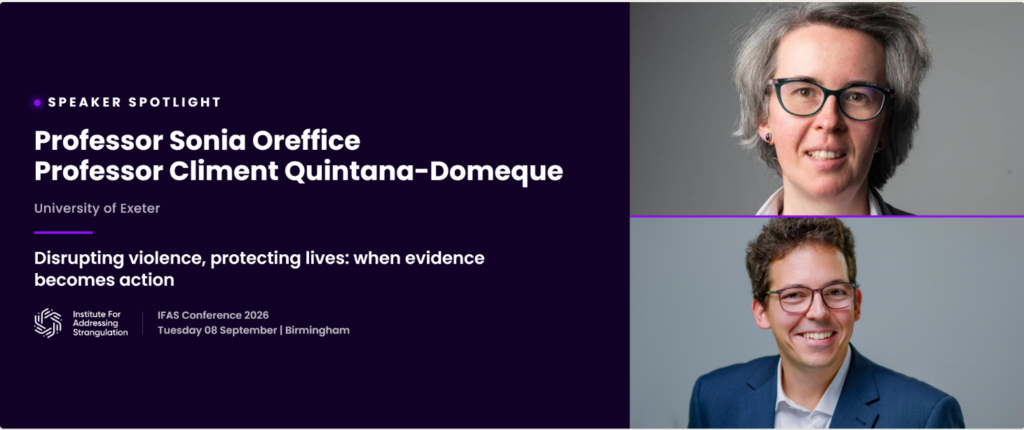
Disrupting violence, protecting lives: when evidence becomes action
“I am incredibly grateful to survivors for speaking up, for showing and emphasising what is not working well in the justice system.”
For Professor Sonia Oreffice, survivors’ experiences are not separate from research into violence. They are fundamental to understanding what systems miss, and to changing them.
Speaking ahead of the IFAS Conference 2026, Sonia reflected on the vital role survivors play in exposing gaps in institutional responses. She also highlighted the need for more systematic data about non-fatal strangulation, arguing that lived experience and rigorous evidence must work together if real progress is to be made in tackling violence against women and girls.
It is a powerful starting point for the work Sonia will present at the conference alongside Professor Climent Quintana-Domeque: research examining whether laws specifically criminalising non-fatal strangulation can help interrupt escalating intimate partner violence before it becomes lethal.
Behind that question lie two distinguished academic careers, concerned in different but complementary ways with understanding people’s lives, inequalities and outcomes.
Human wellbeing as a connecting thread
For Climent, there is a thread connecting research that, at first glance, might appear to span very different worlds.
After completing his PhD in Economics at Princeton University, his research has examined how early-life environments, public infrastructure and economic, environmental and violent shocks shape health and material wellbeing across the life course. His work has studied the relationship between conditions at birth and adult height, the impact of infrastructure on poverty and living standards, and the effects of economic crises, natural disasters and terrorist attacks on birth outcomes.
Yet, these questions have always returned to one central idea: human wellbeing.
Human wellbeing, Climent argues, is multidimensional. His work has therefore sought to understand the different forces and interventions that affect people’s lives, and, crucially, to establish not simply what is happening, but what causes outcomes to change.
That journey has taken Climent through academic positions at the University of Alicante and the University of Oxford to the University of Exeter, where he is Professor of Economics and Subject Lead for Applied Microeconomics.
His contribution to the discipline also extends beyond his own research. He has supervised ten PhD students to completion, served as Editor of the Oxford Bulletin of Economics and Statistics from 2018 to 2026, and contributes to the wider economics profession through the Royal Economic Society.
Understanding gender, inequality and intimate partner violence
Sonia brings more than two decades of research spanning labour economics, family and household behaviour, gender, sexual orientation and discrimination.
A Professor of Economics at the University of Exeter since 2018, Sonia is also Deputy Director of Research and Impact for Economics. Her academic career has included positions in the United States, Spain and the UK, including Clemson University, the City College of New York, the University of Alicante and the University of Surrey.
Across that career, Sonia has examined how gender, power, inequality and economic circumstances shape people’s experiences and decisions within households and families. Her more recent research on intimate partner violence and non-fatal strangulation builds naturally on this longstanding interest, extending it to some of the most serious forms of harm experienced within intimate relationships.
It is here that Sonia and Climent’s research journeys converge particularly powerfully.
Can recognising non-fatal strangulation in law save lives?
Together with Dércio de Assis and Arpita Ghosh, Sonia and Climent have undertaken research asking an enormously consequential question:
Can laws specifically criminalising non-fatal strangulation reduce intimate partner homicide?
Their study, Disrupting Violence, Protecting Lives: Strangulation Laws and Intimate Partner Homicides, uses almost three decades of US homicide data and the staggered introduction of standalone non-fatal strangulation laws across US states to investigate what happens to intimate partner homicide following legal reform.
Importantly, the researchers use causal-inference methods designed to move the analysis beyond simply identifying a relationship between two things, towards understanding whether the introduction of these laws itself changes outcomes.
Their research finds that standalone NFS laws reduce female-victim intimate partner homicide by 14% and male-victim intimate partner homicide by 27% among adults aged 18–49 in the US jurisdictions studied.
The researchers found no corresponding effect on stranger-perpetrated homicides, an important comparison in assessing whether the change is specific to intimate partner violence rather than reflecting a broader change in homicide trends.
For Climent, the significance of this work lies partly in what non-fatal strangulation can tell us about escalating risk.
As he explained:
“There is strong evidence suggesting that non-fatal strangulation is a very important warning sign that domestic violence is escalating to potentially lethal levels.”
That makes the question of intervention particularly important. If non-fatal strangulation can signal escalating and potentially lethal violence, what happens when criminal justice systems recognise it specifically, rather than allowing it to disappear within broader categories of assault?
Their research provides evidence that standalone laws may have an important role in interrupting that trajectory.
From research to policy
The significance of this work is already moving beyond academia.
Research by Sonia, Climent and their colleagues has informed discussion around non-fatal strangulation legislation and policy, including in Scotland and Jersey.
The research was cited in a Scottish Parliament motion concerning the creation of a standalone offence of non-fatal strangulation and was discussed during the subsequent parliamentary debate in January 2026. It was also referred to during consideration of Jersey’s standalone strangulation legislation, adopted in March 2026.
That journey, from data to evidence to policy and ultimately to the protection of people experiencing abuse, sits at the heart of what Sonia and Climent will bring to the IFAS Annual Conference.
But evidence is only as strong as the information available to researchers in the first place.
And that brings the conversation back to where Sonia began: survivors.
Listening to survivors and learning from the data
During our conversation, Sonia spoke particularly about the gaps that remain in data around non-fatal strangulation, including understanding how many cases occur, what happens when they enter systems, and what survivors’ experiences tell us about where those systems are working and where they are not.
For Sonia, survivors who speak about those experiences play an important role in making change possible. While selection issues may be present, their voices can expose what statistics alone cannot, revealing how violence escalates, how institutions respond, and what existing data sources fail to capture.
At the same time, better and more systematic data can help researchers, practitioners and policymakers understand patterns that individual cases alone cannot reveal.
Bringing those two forms of knowledge together, lived experience and rigorous evidence, can help us ask better questions about what needs to change.
It is also a reminder that behind every dataset used to understand intimate partner violence are real people and real experiences.
Research with the potential to protect lives
At the IFAS Annual Conference 2026, Sonia and Climent will take delegates inside the evidence behind their work and into a wider conversation about what research can tell us about recognising risk, disrupting escalating violence and informing effective institutional and legislative responses.
For Climent, the ultimate ambition for this research is clear:
“I hope that our research can strengthen understanding, improve institutional responses, and ultimately support better protection for survivors of non-fatal strangulation.”
It is an ambition that brings us back to human wellbeing, and to the reason evidence of this kind matters beyond academia.
Research can help us understand risk. It can test whether interventions work. It can identify where systems need to change. And, when that evidence reaches practitioners and policymakers, it has the potential to contribute to something much more fundamental: preventing violence and protecting lives.
At the IFAS Annual Conference 2026, Professors Sonia Oreffice and Climent Quintana-Domeque will share their research and its implications for our understanding of non-fatal strangulation, intimate partner violence and prevention.
For practitioners, researchers, policymakers and professionals across the criminal justice system, their session poses an important question: how can we turn evidence about non-fatal strangulation into action that protects lives?
