Creating Space for Better Conversations
Why education about non-fatal strangulation must go beyond simply telling young people “don’t do it”
For more than two decades, Jonny Hunt has spent his career doing something many people would shy away from: walking into classrooms and having honest conversations with young people about relationships, consent, masculinity, sexuality and the questions they are often afraid to ask.
Having worked across education, including primary, secondary, alternative and SEND, and now serving as Senior Lecturer in Applied Social Science and Course Lead for BA Childhood and Youth Studies at the University of Bedfordshire, Jonny has built a career around helping both young people and professionals navigate some of society’s most challenging conversations.
It is this experience that has led him to become increasingly interested in how schools approach emerging issues – including non-fatal strangulation.
With updated Relationships, Sex and Health Education (RSHE) guidance introducing strangulation into the curriculum, educators are now being asked to teach a topic that many acknowledge is both sensitive and complex.
For Jonny, the challenge isn’t whether these conversations should happen.
It’s how they happen.
“Teachers are being asked to cover strangulation and choking, but they’re not being given the guidance or support about how to do it safely.”
Moving beyond simple messages
Throughout his career, Jonny has seen a recurring pattern.
When difficult topics emerge, education often defaults to clear rules, warnings and legal information. While these messages have an important place, he believes they rarely equip young people to navigate the complexities of real life.
Whether discussing consent, image sharing or healthy relationships, he argues that meaningful education begins by creating opportunities for conversation rather than simply delivering information.
“Historically we go through these moral panics where we simply tell young people, ‘Don’t do it.’ That doesn’t really help them navigate those issues.”
Instead, Jonny advocates for creating classroom environments where curiosity is welcomed, questions are encouraged and young people are given space to explore difficult topics without fear of judgement.
Holding on to the evidence while improving the conversation
At IFAS, one message remains unequivocal:
There is no safe way to strangle.
The evidence is clear about the potentially devastating consequences of strangulation.
Jonny believes that this evidence should remain central to education. However, he also believes that educators need confidence in how those conversations are introduced and facilitated.
Rather than viewing evidence and education as competing approaches, he sees them as complementary.
The challenge, he explains, is creating learning environments where young people are willing to engage with that evidence rather than disengage from it.
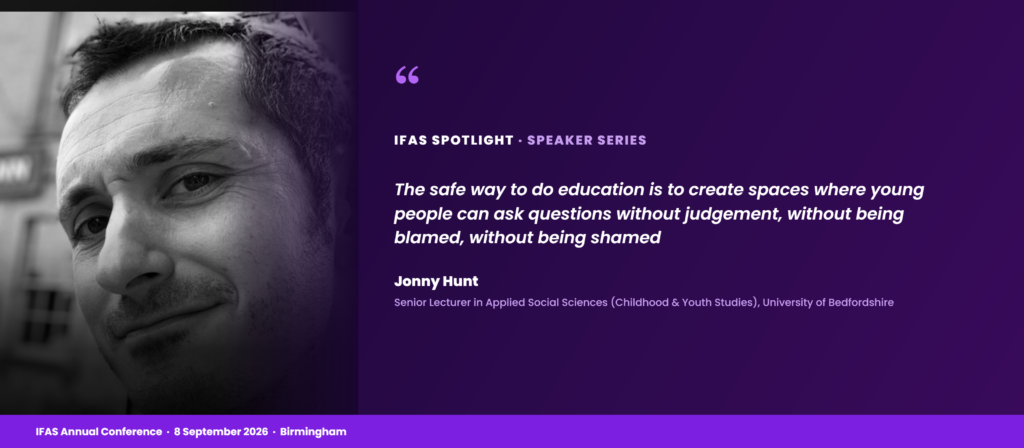
“The safe way to do education is to create spaces where young people can ask questions without judgement, without being blamed, without being shamed.”
Making space for difficult questions
One of the recurring themes throughout Jonny’s work is that young people rarely benefit from being handed simple answers to complex situations.
Instead, they need opportunities to think critically, explore uncertainty and understand how communication, relationships and consent operate in the real world.
That approach has led him to develop with his colleague Dr Emily Setty what he describes as “a safe uncertainty approach to RSE”– a framework that encourages educators to move beyond prescriptive teaching and instead create meaningful dialogue.
“We want young people to leave with more questions than they came in with,” he explains.
“A really good session doesn’t have everybody thinking they’ve got all the answers. It should be the start of the conversation, not the end.”
Why language matters
One of the most important discussions currently taking place is not only what should be taught, but how these conversations are framed.
Jonny believes that clarity of language matters.
He argues that conversations about abusive strangulation, coercive behaviour and violence should be distinguished from broader discussions about relationships, communication and the ways young people learn about intimacy.
Without that clarity, he suggests, educators risk confusing different issues rather than helping young people understand them.
Equally important is recognising that many young people’s understanding of strangulation is shaped not only by pornography, but by broader social media, online content, popular culture and peer conversations.
Education therefore has an opportunity – not simply to correct misinformation – but to help young people critically examine where those messages come from and what the evidence tells us.
Building confidence, not closing conversations
Throughout the interview, Jonny returns repeatedly to one idea.
Education should not close conversations down.
It should open them up.
He recalls numerous occasions where the most meaningful learning happened not during the lesson itself, but afterwards, when a young person returned later to continue the conversation and to ask another question, or seek support.
For Jonny, those moments are often the true measure of success.
“What I’m really interested in is what we can say that means young people come back later and ask another question or ask for help.”
Continuing the conversation
These are precisely the questions Jonny will explore at the IFAS Conference, “Addressing Strangulation in the Violence against Women and Girls Strategy: Building a Safer Society for All” this September, where educators, researchers, clinicians and practitioners will come together to consider how evidence can be translated into meaningful, age-appropriate conversations with children and young people.
His session will explore how non-fatal strangulation can be thoughtfully embedded within wider discussions about relationships, consent, communication and healthy behaviours – supporting educators to navigate one of the most challenging additions to the RSHE curriculum.
As IFAS continues to work with partners across education, healthcare, safeguarding and research, these conversations are likely to become increasingly important.
Not because anyone claims to have all the answers.
But because creating safe spaces to ask difficult questions may be one of the most powerful ways to keep young people safe.
